Article
A Storm is Brewing in Las Vegas. Can the Golden Knights Withstand a Category 5?
A look at Carolina's territorial pressure, why the Hurricanes are so hard to dislodge, and where the Golden Knights still have a path.
Written by: Andrew, Creator of Golden Edge Analytics
5/31/26
It all comes down to this.
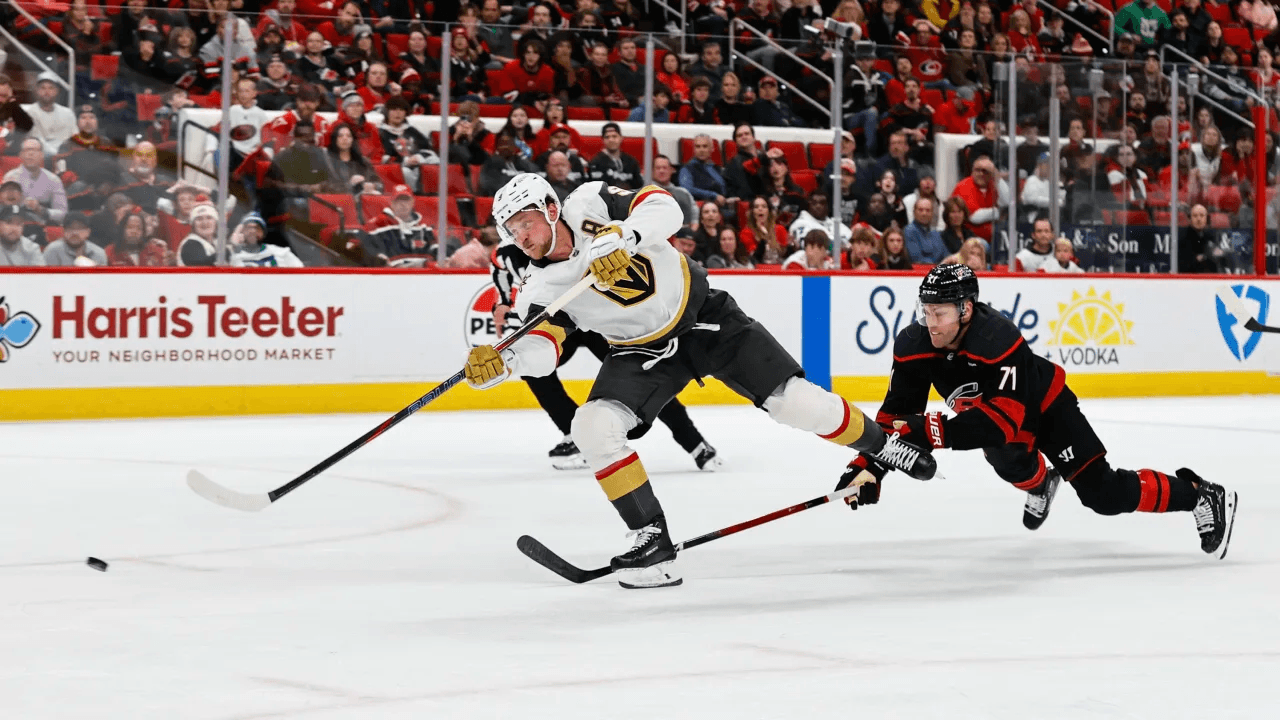
What many are calling a Davis vs. Goliath matchup, the Vegas Golden Knights are walking into a series against the NHL's most territorially dominant team.
The numbers behind Carolina's playoff run explain why they have been so difficult to beat. According to NHL EDGE, the Hurricanes have spent 47.2% of their playoff ice time in the offensive zone while spending only 35.1% in the defensive zone. Vegas sits at 41.2% offensive-zone time and 40.2% defensive-zone time. Carolina also enters the Final with a +11.4 shot-attempt differential per game compared to Vegas' -2.8. Their shots-on-goal differential is +2.2 while Vegas sits at -0.1.
Those numbers are not just evidence that Carolina is winning games. They illustrate the central challenge Vegas faces. The Hurricanes spend more time attacking than almost any team in hockey, and their entire system is designed to turn offensive-zone possession into cumulative pressure.
What makes Carolina especially dangerous is that the territorial advantage is not driven by one line. Nine of the ten forwards who spend the highest percentage of their ice time in the offensive zone during these playoffs are Hurricanes. The top five defensemen in offensive-zone time percentage are also Hurricanes. Carolina's ability to control territory is spread throughout the lineup, which is one of the reasons they have rolled through the Eastern Conference with a 12-1 record.
That depth becomes particularly important when looking at Carolina's second line. The Hall-Stankoven-Blake line enters the Stanley Cup Final carrying a 71.2% expected-goal share according to MoneyPuck, the highest mark of any playoff forward line with at least 50 minutes played together. When that trio is on the ice, Carolina is controlling nearly three-quarters of the expected goals. That creates a difficult matchup problem for Vegas. Most teams can devote their attention to slowing down a first line of Carolina's stature and feel reasonably comfortable afterward. Carolina does not offer that luxury. Taylor Hall and Logan Stankoven have been two of the Hurricanes' most effective forwards this postseason, and their underlying numbers suggest the production is fully supported by the quality of chances they are creating.
Most discussions about Carolina's defense begin with Jaccob Slavin, and for good reason. However, the strength of the Hurricanes' defensive group extends far beyond one player. The Walker-Miller pairing enters the Final with a 65.5% expected-goal share. The Gostisbehere-Nikishin pairing sits at 65.1%. Those are the two highest marks among defensive pairings in the playoffs. Carolina is not simply receiving strong play from its top pair. Multiple defensive pairings are consistently driving play toward the offensive zone, which makes the Hurricanes difficult to wear down over the course of a seven-game series.That places a significant burden on Vegas' defense.
Shea Theodore may be the most important defenseman in the series because his ability to escape pressure directly attacks one of Carolina's biggest strengths. The Hurricanes want opposing defensemen making rushed decisions under forechecking pressure. Theodore's skating allows him to break those sequences before they begin. His 23.28 mph top speed ranks 8th among all skaters who have appeared in the 2026 Stanley Cup Playoffs and 2nd among defensemen. Noah Hanifin's 22.72 mph top speed ranks 6th among playoff defensemen. Those numbers matter because Carolina's forecheck depends on closing time and space quickly. Vegas possesses defensemen with the mobility necessary to challenge that pressure. Rasmus Andersson provides a different element. His 5.24 miles skated in a single playoff game ranks 10th among all players in the postseason. Carolina's system demands constant movement and repeated retrievals. Vegas will need defensemen capable of handling that workload.
Up front, the Golden Knights have several reasons to feel confident entering the matchup. The Eichel-Barbashev-Dorofeyev line has been one of the most effective lines in the playoffs, posting a 72.7% goals-for percentage and a 57.4% expected-goal share. Carolina may control territory better than almost any team, but Vegas possesses a line that has consistently converted its opportunities while still driving play in the right direction. Jack Eichel's role extends beyond that line's production.
Eichel ranks 10th among all playoff skaters with 42 shots on goal. Against Carolina, Vegas needs him to do more than score. The Hurricanes are at their best when opponents surrender possession and allow Carolina to establish its forecheck. Eichel is one of the few players in the series capable of consistently carrying the puck through pressure and creating explosive offensive-zone entries.
Mitch Marner presents a different challenge for Carolina. Marner leads all players in the playoffs with 3.7 points per 60 minutes. He is also tied for 8th among all playoff skaters with 16 high-danger shots on goal. Carolina's defensive structure is excellent at eliminating straightforward attacks. Marner's ability to create offense laterally and manipulate defensive coverage gives Vegas a skill set that few opponents possess. Tomas Hertl ranks alongside Marner with 16 high-danger shots on goal, and that statistic highlights an important aspect of Vegas' offensive approach. The Golden Knights have generated a significant amount of offense from dangerous areas around the crease rather than relying solely on volume shooting.
That trend appears again when looking at Brett Howden and Pavel Dorofeyev.
Both players are tied for the playoff lead with six high-danger goals. Howden is also shooting a whopping 35.7%, the highest shooting percentage among playoff skaters, minimum 5 games.
Carolina generates offense through volume, territorial control, and sustained pressure. Vegas generates offense through efficiency, net-front presence, and finishing talent. The goaltending matchup reflects a similar contrast.
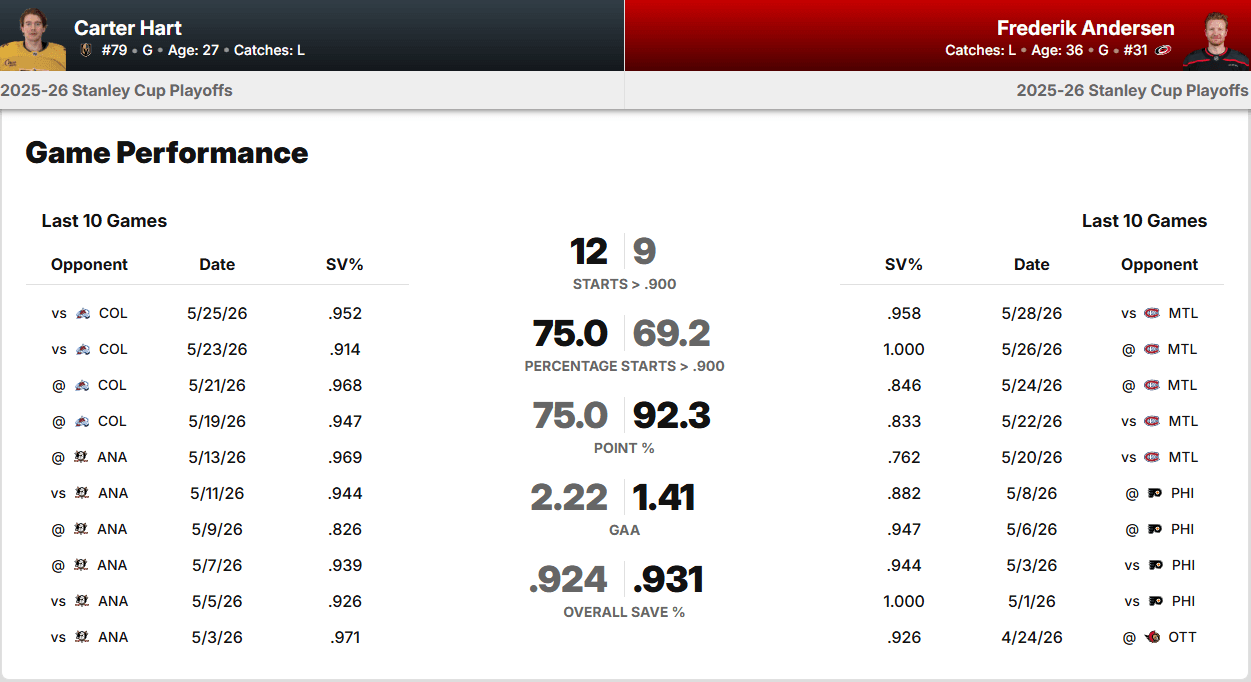
Frederik Andersen enters the Final with a .931 save percentage, a 1.41 goals-against average, and 11.5 Goals Saved Above Expected. He has been one of the biggest reasons Carolina has been able to turn territorial dominance into such overwhelming results. Carter Hart has been nearly as important for Vegas. Hart owns a .924 save percentage, a 2.22 goals-against average, and 7.7 Goals Saved Above Expected. More importantly, his 12 quality starts are the most by any goaltender in the 2026 Stanley Cup Playoffs. His .873 high-danger save percentage ranks 4th among playoff goaltenders, ahead of Andersen's .857 mark. That distinction could matter in this series.
There is one final question surrounding Carolina.
For years, the Hurricanes have been one of hockey's strongest analytical teams. They consistently finish near the top of the league in expected goals, shot share, and territorial metrics. Yet deep playoff runs have often ended before the Stanley Cup Final. Why can they never get over the hump?
One possible explanation is the physical demand of Brind'Amour's system. Carolina's identity depends on aggressive forechecking, constant pressure, and sustained effort over long stretches of games and seasons. That style has produced elite results, but it also asks a tremendous amount from players over the course of nearly 100 games.
To Carolina's credit, this year's path has been far less demanding than previous runs. Their 12-1 playoff record means they have played only one game more than the minimum possible through three rounds. If there was ever a season for Carolina to arrive in the Stanley Cup Final with fresh legs, it is this one.
The formula for Vegas is relatively straightforward, even if executing it will be extremely difficult. The Golden Knights have to prevent Carolina from establishing extended offensive-zone pressure. If Carolina controls territory the way it has throughout the first three rounds, the numbers suggest the Hurricanes will eventually take over the series. If Vegas can force Carolina to spend extended stretches defending, then the most territorially dominant team in hockey will be forced into a type of game it rarely has had to play this postseason.